

INDUSTRY INSIGHTS
Stress isn’t disappearing from work. The question is whether we’re designing workplaces that help people recover from it.
For years, workplace wellness has focused largely on encouraging healthier behaviors: gym memberships, meditation apps, standing desks, healthy snacks, and employee assistance programs.
These initiatives can all have value. But they don’t necessarily address one of the fundamental challenges of modern work: people spend much of their day in a state of sustained cognitive and physiological activation, with very few opportunities to truly disengage and recover. Meetings transition directly into emails. Emails are interrupted by messages. Lunch happens in front of a screen. Even a five-minute break often becomes five minutes looking at a phone. The result is a workforce under significant pressure.
The Numbers Are Difficult to Ignore
According to Gallup’s State of the Global Workplace 2026, 40% of employees globally experienced significant stress during much of the previous day. In the United States, that number rises to 50% of employees. The consequences extend well beyond employees simply “feeling stressed.”
The World Health Organization estimates that 12 billion working days are lost globally every year to depression and anxiety, at an estimated cost of $1 trillion annually in lost productivity. WHO notes that poor mental health can affect productivity, absenteeism and employee retention. Research from the American Psychological Association provides another window into the problem. In its Work in America research, 77% of workers reported experiencing work-related stress in the previous month, with workers reporting consequences including emotional exhaustion, reduced motivation, lower productivity and a desire to quit.
Burnout can also become a retention problem. SHRM research found that employees experiencing burnout were nearly three times as likely to be actively looking for another job—45% versus 16% among employees who weren’t reporting burnout. These aren’t simply wellness statistics. They’re business statistics.
Absenteeism Is Only Part of the Problem
When we think about workplace stress, we often think about people missing work. But absenteeism is only one part of the economic impact. There’s also presenteeism: employees are physically at work but are operating with diminished energy, concentration, motivation, or productivity. WHO’s analysis of the economic burden associated with depression and anxiety includes absenteeism, presenteeism and employee turnover among the ways diminished mental health translates into lost productivity.
That distinction matters. An employee doesn’t have to call in sick for stress to affect an organization. They can be sitting at their desk.
We’ve Optimized Work. Have We Optimized Recovery?
Over the past several decades, organizations have invested enormous resources into helping people work more efficiently. We have faster computers, better communication platforms, AI tools, project management software, collaboration systems, and increasingly sophisticated workplaces. But comparatively little attention has been paid to something equally fundamental:
How do people recover during the workday?
Human beings aren’t designed to maintain peak cognitive performance indefinitely. Periods of focused activity naturally need to be balanced with periods of recovery. Yet in many workplaces, the primary recovery environment is still the break room—or a phone.
From Workplace Wellness to Workplace Recovery
We believe the next evolution of workplace wellness will increasingly focus on recovery infrastructure. That doesn’t mean eliminating stress. Some stress is unavoidable, and challenging work can be meaningful and rewarding.
The opportunity is to give people better tools and environments to transition out of heightened activation throughout the day.
That could include spaces and experiences designed around:
- Nervous system regulation
- Guided breathwork
- Meditation
- Sensory reduction
- Immersive sound
- Rest
- Light
- Physical vibration
- Short periods of intentional disconnection
Instead of treating recovery as something that happens after work, organizations can begin making it accessible during the workday.
Why the Physical Environment Matters
There’s a significant difference between having access to a wellness app and having an environment that actually encourages you to stop.
Imagine trying to meditate while sitting at your desk.
Your computer is open. Notifications are appearing. Conversations are happening around you. Your phone is within reach. The environment itself is signaling: Keep working.
A dedicated recovery environment sends a very different signal. It creates a physical boundary between activity and recovery.
That may be one reason we’re seeing increasing interest in dedicated wellness rooms, meditation spaces, recovery technologies, and restorative amenities across workplaces, healthcare environments, hospitality, fitness, and commercial real estate.
Making Recovery Practical
For recovery to become part of workplace culture, it also has to be realistic. Most employees aren’t going to disappear for an hour in the middle of the day.
But 10–15 minutes is different.That’s the idea behind OpenSeed. OpenSeed creates private, multi-sensory environments where people can step away from external stimulation and engage in short, guided experiences designed around nervous system regulation and recovery.
Depending on the experience, the OpenSeed Platform can bring together guided breathwork and meditation, immersive audio, dynamic lighting, vibroacoustic stimulation, and other wellness modalities within one environment.
Across our growing network, we’re currently seeing an average of approximately 11 sessions per pod, per day. For us, that utilization is an encouraging signal.
People don’t just need wellness resources.They need accessible places to recover.
The Workplace of the Future May Be Designed Around Both Performance and Recovery
The conversation around workplace wellness is changing. The next generation of workplaces may not simply ask:
How do we help people perform better?
They may also ask:
How do we help people recover so they can continue performing well?
As organizations rethink offices, hospitals, hotels, fitness clubs, and other shared environments, recovery could increasingly become part of the physical infrastructure itself.
Because perhaps the future of high performance isn’t about asking people to push harder.
It’s about designing environments that make it easier to reset.

The Science Behind Breathwork and Why the Way We Breathe Matters
Breathing happens automatically thousands of times each day, usually without us thinking about it. But unlike many processes controlled by the autonomic nervous system, breathing can also be consciously changed.
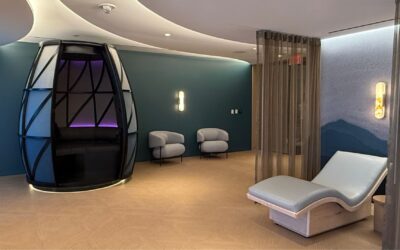
OpenSeed Brings Workplace Recovery to Hilton’s Global Headquarters
OpenSeed recently completed the installation of an Iris pod at Hilton’s global headquarters in McLean, Virginia, bringing a dedicated space for short, restorative breaks into one of the world’s most recognized hospitality companies.

Red Light Therapy, Integrated Into the OpenSeed Experience
Red Light Therapy uses specific wavelengths of red and near-infrared light and has become increasingly common across wellness, recovery, fitness, and longevity environments.
OpenSeed
Immersive wellness environments for the home + workplace.